
Intelligent Manufacturing € August € 1996 € Vol. 2 € No. 8
Intelligent Manufacturing € August € 1996 € Vol. 2
€ No. 8
A couple issues ago, we took a look at a U.S. Government-sponsored
effort to improve manufacturing throughout the U.S. industrial base
(Intelligent Manufacturing, June 1996). We've
invited Brian Willoughby with the U.S. Navy's Best Manufacturing
Practices Center of Excellence to explain how the implementation of
intelligent systems - particularly a knowledge-based risk management
system - has produced substantial, measurable improvements to date.
- The Editors
Risk management is a term very much in vogue and talked about these
days. However, most risk management methods are poorly effective at
best.
The problem is that they are based on a faulty pretext. Typically,
risk management is done based on a mathematical metric evaluated
against cost and schedule values. Tests conducted on these methods
have shown them to be only about 30% repeatable, i.e., if two
different "experts" do an analysis, 30% of their results will be in
common. Repeatability is the name of the game in a low-risk design
and manufacturing environment.
Furthermore, doing risk management based on cost and
schedule-tracking systems is a misnomer. Once indications are seen in
these systems, the issue is no longer a risk but a program problem.
Because of this, what is often talked about as risk management is
actually problem management.
Computer Sciences Corporation (CSC), along with the Navy Best
Manufacturing Practices Center Of Excellence (BMPCOE), have developed
the Technical Risk Identification & Mitigation System (TRIMS)
methodology and software. The TRIMS methodology is based on a
knowledge-based, process-oriented approach to risk management.
As shown in Figure 1, the TRIMS definition of risk is a function of
probability and effect. Probability is purely a function of
statistics (that is where the word comes from), and statistics are
purely a function of past experience. That's why TRIMS uses a
knowledge-based approach to risk management.
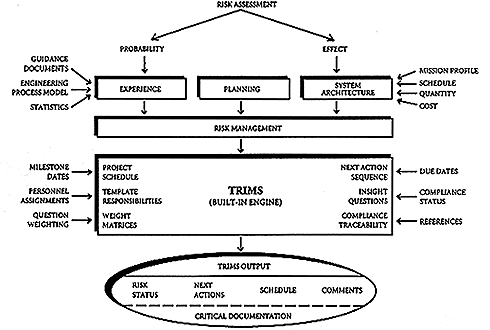
Figure1. TRIMS can be tailored to an Acquisition/Development
Program
Effect is purely a function of systems architecture. If one program
is building a prototype machine gun and another is building 10,000
printed circuit boards, questions on activities like computer-aided
manufacturing will be weighted quite differently.
To develop a knowledge base to do risk management at the product
level is next to impossible due to the almost infinite size of the
knowledge base needed to review criteria for every type of product
conceivable. (However, a knowledge base can be developed for a
specific product sector). The goal of risk management is early
identification of potential problems, and after some research, it
became obvious to us that we should be monitoring the development
process - not the product - to receive the earliest indication of
problems.
This also gave us a major breakthrough in the development of the
TRIMS methodology. When you are monitoring the process instead of the
product, the knowledge base essentially becomes finite and
product-independent. In other words, we don't care as much what you
are building as we do how you are building it.
If we add a third element - planning - to the above mix, we end up
with risk management vs. risk assessment.
Tailoring will always improve any process and the TRIMS methodology
allows for this to take place. Product-oriented templates can be
developed by the user and added to the knowledge base.
The TRIMS Systems Engineering knowledge base has been developed over
the past 10 years from experience gained by the U.S. Navy, Department
of Defense and companies like Bell Laboratories. It is extensive and
has proven itself effective on many military programs. TRIMS's
repeatability, when done by independent assessors, is typically in
the 60-70% range; while this is not perfect, it is a great
improvement and value-added for the effort expended.
The TRIMS software helps the user through a structured approach to
collecting data and answering questions in its knowledge base.
Currently, the TRIMS software is a DOS-based program (which runs well
in a DOS window under MS-Windows), but a conversion and capabilities
upgrade to the Windows environment is underway with release expected
later this year.
Brian Willoughby is manager of the Program Managers Workstation
(PMWS) program at the U.S. Navy's Best Manufacturing Practices (BMP)
Center of Excellence (COE), College Park, Md. He can be contacted at
(301) 403-8100 or
[email protected]